

What Not to Do If You Have Epicondylitis
Does your elbow hurt when you lift your coffee cup or turn a door key? These are some of the symptoms suffered by people suffering from epicondylitis or, as it is commonly called, "tennis elbow". In this article we clarify what not to do with epicondylitis and explain everything you need to know about this annoying pathology.
What is epicondylitis and why does it happen?
In order to understand what not to do if you suffer from epicondylitis, it is important to understand what epicondylitis is and what causes it.
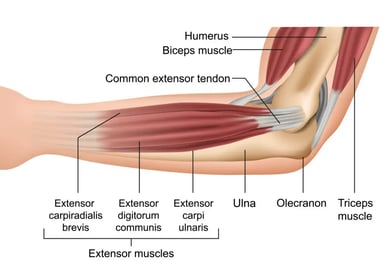
It consists of an inflammation of the tendons of the muscles on the outside of the elbow. This injury also affects the extensor muscles of the wrist and fingers and the muscles that make possible the supination of the forearm, that is to say, the movement that allows the palm of the hand to look upwards.
In the following illustration you can appreciate the musculature involved in this injury and that we have commented in the previous paragraph.
The most common causes of epicondylitis are:
- Practice of racquet sports.
- Professions that require overuse of the muscles involved (painters, carpenters, butchers, cooks, among others).
- Repeated use of the computer mouse.
All of them involve repetitive tasks that cause inflammation and degeneration of tendon fibers.
Interestingly, there has been a paradigm shift in the consideration of this injury. In recent years, several histopathological studies have shown that inflammation is not the most relevant process and that what occurs in these pathologies is more typical of a degenerative process. That is why the most correct term to refer to this pathology would be epicondylosis.
What not to do with epicondylitis
This is the central theme of our article. So now that you know what this condition consists of and why it happens, we list the things you should not do with epicondylitis:
- Don't keep performing the repetitive motions that produce and aggravate the injury. The first measure to take is to avoid those same gestures so that the muscles involved can rest.
- If it is caused by a professional reason, epicondylitis is a reason for sick leave given by the family doctor. After rest and improvement, you should adopt prophylaxis measures so as not to encourage a relapse of the same injury.
- If the epicondylitis appears for a recreational reason or of daily habits, we will also have to stop the activities that provoke it, for example, to stop practicing racket sports .
After following the indicated treatment, we should also take preventive measures. We recommend the following:
- Perform warm-up exercises prior to use of the muscle groups involved in pronation/supination and flexion/extension movements of the forearm and wrist.
- Avoid actions that involve prolongedwrist extension.
- Do not perform forced movements of pronation and supination that involve an increase in the tension supported by the tendons.
- In case of not being able to avoid some of the previous movements, you can use an elbow brace in punctual moments, to avoid the muscular overload.
Symptoms and treatment of epicondylitis
The symptoms of epicondylitis are easily identifiable:
- Pain on the outside of the elbow with irradiation to the forearm.
- Pain and lack of functionality when supinating the forearm with the wrist extended.
- Pain when palpating the external zone of the epicondyle.
- Pain when performing common movements such as lifting a cup or practicing a backhand in paddle.
- Poor grip strength.
- Insidious pain that does not subside, especially at night, something frequent also in other problems such as ankle pain at night.
The symptomatology is gradual. At the beginning of the injury the pain appears when performing the action or actions that cause it. Later, if continued overuse continues, the pain becomes chronic and remains even at rest.
Mobility of the elbow is not altered. In some cases, epitrochleitis, pain associated with the internal part of the elbow, may occur due to compensatory overuse, given the pain and decreased functionality of the external part of the elbow.
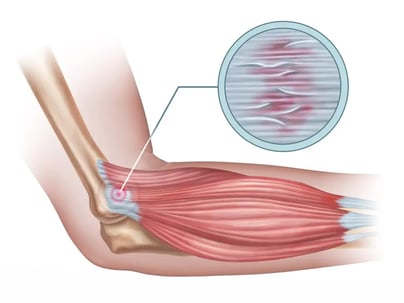
The treatment is conservative, that is to say, it is recommended to adopt measures to reduce the inflammation as those that we comment to you next and, mainly, it is required the cessation of the overuse of the musculature. In this way, it is intended to avoid the chronification of the injury and having to apply more aggressive methods such as infiltrations or surgery.
These measures are:
- Cryotherapy. Apply a cold pack or cold gel on the affected area for several minutes, five or six times a day. A product such as Silicium G7 Sport Gel 150 ml is the best natural alternative to classic treatments for its decongestant effect. Its ingredients help to relax overloaded tendons and joints, improving strength, endurance and elasticity.
- Rest during the acute phase.
- Avoid using the hand in pronation, that is, with the palm of the hand facing downwards.
- After the acute phase, it is recommended to perform flexibility exercises and stretching of the flexor muscles to relieve muscle inflammation. It is always best to do this, especially the first few times, under the supervision of a physiotherapist.
After the improvement and medical discharge if it is the case, as it happens in other articular injuries, it is possible to return to the accomplishment of the daily activities using a strap or preventive band and carrying out in a routine way the exercises indicated by the physiotherapist.
Preventive exercises for epicondylitis
Example of some suitable exercises to avoid this injury.
Stretching of the wrist flexor
Keep the affected arm stretched, keeping the elbow straight and the hand with the palm facing upwards. Hold the fingers of the hand of the affected arm with the other hand and pull gently. Hold the stretch for 30 seconds.
Weight-bearing wrist flexion resistance
With the forearm resting on a table, leave the hand off the edge with the palm up holding a light dumbbell.
Flex wrist, slowly lower and extend to return to start. Repeat 10 times.
Resisting hand and finger grip with a towel.
Hold and twist a rolled towel with both hands in either direction. Repeat 10 times.
If you suffer or have ever suffered from this injury, you know how painful it can be. Therefore, knowing what not to do with epicondylitis is important to avoid aggravating it, as well as taking appropriate preventive measures.
