

Organic silicon: what it is and how it works in the body, according to science
Silicon is the second most abundant element in the earth's crust. In the human body it is a trace element: it is present in small concentrations but fulfills functions that no other mineral can replace. It is involved in the synthesis of collagen and elastin, in bone mineralization, in the integrity of connective tissue and in the function of multiple enzyme systems.
The problem is not its biological importance, which is well documented. The problem is bioavailability. Most of the silicon present in foods and low quality supplements is not absorbed to any significant extent. The form in which the silicon is chemically presented determines whether the body can take it up or whether it is eliminated by the body without being used.
This guide explains what organic silicon is, why its chemical form matters, what functions it has documented in the scientific literature, and how to distinguish a supplement with real evidence from one that is just marketing.
What is silicon and why does the body need it?
Silicon (Si) is a metalloid that almost never occurs in nature in its pure form. It is found combined with oxygen to form silicates and silicon dioxide (SiO₂), which are the predominant forms in rocks, soils and plants.
In the human organism, silicon is mainly concentrated in tissues with high collagen and glycosaminoglycan synthesis activity: skin, bones, cartilage, tendons, blood vessels and lungs. Its concentration is especially high in young, active tissues, and decreases progressively with age - which has led researchers to study its possible relationship with connective tissue aging.
Documented biological functions of silicon include:
Collagen synthesis. Silicon acts as a cofactor in the hydroxylation of proline and lysine, two critical steps in the formation of collagen chains. Without adequate silicon, collagen chains are not properly stabilized and tissue strength decreases.
Elastin synthesis and cross-linking. Silicon participates in the elastin crosslinking process, which is necessary for this protein to have the elastic functionality that allows tissues to regain their shape after stretching. Without this crosslinking, elastin is structurally unstable, thus acting as a stabilizing cofactor.
Bone mineralization. Silicon is present in the organic matrix of forming bone and has been associated with bone mineral density. Epidemiological studies have found positive correlations between bioavailable silicon intake and bone density in adult populations.
Immune and anti-inflammatory function. Silicon participates in the regulation of some inflammatory mediators and has interactions with aluminum that have generated research interest in the context of neuroprotection.
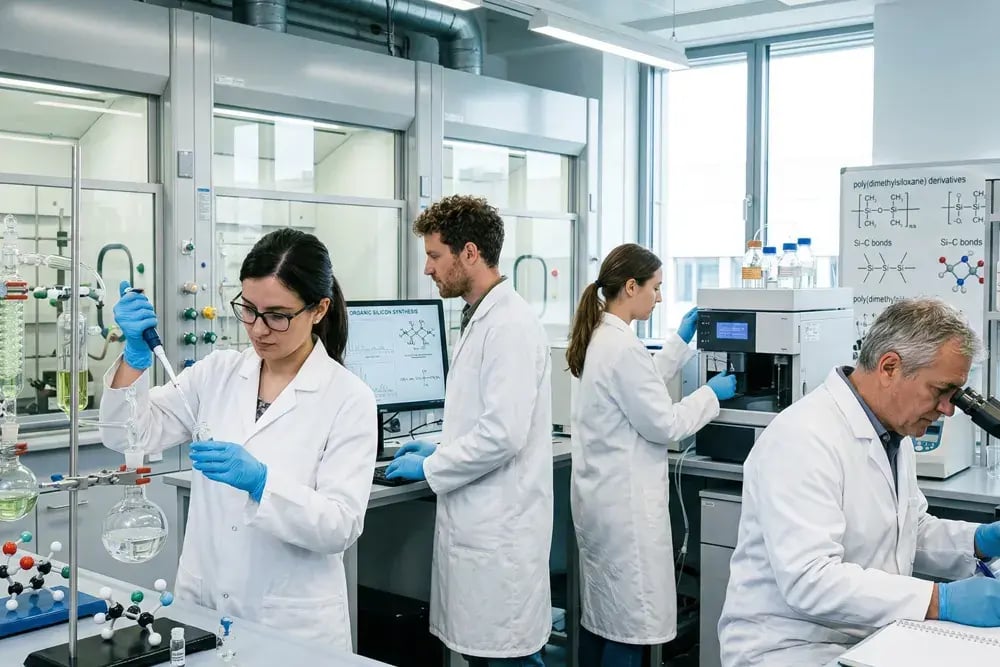
The key issue: silicon bioavailability and chemical forms.
Not all silicon is the same. This is probably the most important distinction a consumer can understand before choosing a supplement.
Inorganic silicon: low or no absorption
Silicon dioxide (SiO₂) and silicates are the most common forms in nature and in many inexpensive supplements. The problem is that these forms are practically insoluble in water and the human intestine cannot absorb them to any significant extent. They reach the body and are eliminated without being utilized by the tissue.
Silicon dioxide is also widely used as a food additive (E-551) in processed products and as an excipient in tablets. Its presence in these products does not provide biological benefit.
Orthosilicic acid - the bioavailable form
Orthosilicic acid (Si(OH)₄) is the soluble monomeric form of silicon, the only one that the small intestine can absorb efficiently. In nature it occurs in water and in some foods in small amounts. The problem is that pure orthosilicic acid is unstable in solution: it tends to polymerize spontaneously forming chains that are no longer bioavailable.
Research in silicon supplementation has focused on stabilizing orthosilicic acid so that it maintains its bioavailable monomeric form until it reaches the intestine. Choline-stabilized orthosilicic acid (ch-OSA) is the most clinically studied form, with several trials published in dermatology and rheumatology journals showing documented effects on hair quality, nails, skin and bone markers.
Organic silicon: the concept and the terminological confusion
The term "organic silicon" is technically imprecise from the point of view of formal chemistry - in chemistry, "organic" means containing carbon, and silicon is not carbon. However, in the context of supplementation, "organic silicon" is used to refer to complexes of silicon with organic molecules (which do contain carbon) that enhance its stability and bioavailability.
Silicium's G5, for example, is an organic silicon complex in liquid form specifically developed to maximize the bioavailability of orthosilicic acid. The liquid formulation avoids the stability problems that affect solid formats and facilitates absorption at the intestinal level.
The available evidence onbioavailable organicsilicon compounds- including in vitro studies, animal model studies and human clinical trials - is compiled on Silicium's clinical studies page.
→ Scientific evidence and clinical studies on organic silicon (Silicium).

Which foods contain bioavailable silicon
Silicon is present in many foods, but in widely varying forms and amounts. Foods with the highest bioavailable silicon content are:
Whole grains, especially oats and barley. The silicon in cereals is associated with the fiber in the husk, so refined cereals lose much of their content.
Horsetail(Equisetum arvense), the plant with the highest concentration of bioavailable silicon in the plant kingdom. It is used in infusion or in concentrated extract. Its silicon is in the form of free orthosilicic acid, which explains its tradition of use in connective tissue health.
Mineral water. Some mineral waters rich in silicon (with more than 30 mg/L of soluble silica) are a relevant source of bioavailable silicon. The variability among waters is enormous: some provide significant amounts, others are practically nil.
Beer. Surprisingly, it is one of the best documented food sources of bioavailable silicon, because of its orthosilicic acid content from malted barley. This is not a recommendation for consumption - it is simply a fact that appears frequently in the literature on silicon bioavailability.
Fruits and vegetables in general provide silicon, although in smaller amounts and with variable bioavailability depending on the form in which it is present.
The estimated average dietary intake of silicon in adults in Europe is 20-50 mg/day, mainly from cereals and water. However, the bioavailable fraction of this intake is difficult to estimate because it depends on the chemical form in each food and the food matrix in which it is present.
→ Where is silicon found and what are its properties?
Silicon and deficiency: signs that the body may need more.
Silicon deficiency does not have as definite a clinical picture as iron or vitamin D deficiency, among other reasons because there is no validated serum marker to routinely measure it. However, scientific literature and clinical observation have identified signs that are often associated with suboptimal levels of bioavailable silicon:
Nails that separate into layers, break easily or show pronounced longitudinal ridges. Hair that is thinning, brittle or slow-growing. Skin that loses firmness and elasticity at an accelerated rate. Joints with less resistance or slower recovery after physical exertion. Bones with a tendency to demineralization in analysis.
None of these signs is diagnostic on its own. But when several appear together, especially in people over 40 years of age (when the tissue concentration of silicon decreases more markedly), they make sense as a starting point for evaluating supplementation.
→How to avoid a lack of silicon in the body: signs and solutions.
Silicon and aluminum: a relevant interaction
One of the most interesting lines of research on organic silicon is its relationship with aluminum. Aluminum is a ubiquitous metal in the modern environment (present in kitchen utensils, antiperspirants, some antacid medications and treated tap water) and its accumulation in brain tissue has been studied in relation to neurodegenerative diseases.
Orthosilicic acid in solution has the ability to bind aluminum in the gastrointestinal tract forming hydroxyalouminosilicates that are eliminated via the kidneys, reducing the intestinal absorption of aluminum. This interaction has generated research interest in the context of neuroprotection, although clinical evidence in humans is still limited and ongoing studies are necessary to establish definitive conclusions.
What is documented is that silicon and aluminum compete for the same intestinal absorption sites, and that populations with higher bioavailable silicon intake show lower serum aluminum levels in some epidemiological studies.
Silicon and other micronutrients: documented synergy.
Silicon does not act in isolation. Its effects on connective tissue, skin and bones depend on the simultaneous availability of other micronutrients with which it works in a network:
Vitamin C. Essential cofactor in collagen synthesis. Without vitamin C, hydroxylation of proline and lysine (the same steps in which silicon participates) cannot be completed. Vitamin C and silicon are synergistic in collagen synthesis: deficiency of either limits the result even if the other is at adequate levels.
Selenium. Trace element with antioxidant function through selenoproteins, especially glutathione peroxidase. It protects collagen and elastin fibers from oxidative damage that degrades them. The silicon-selenium-vitamin E combination has been specifically studied in the context of connective tissue aging.
→ Organic silicon, selenium and vitamin E: combined functions.
Zinc. Involved in the activity of more than 300 enzymes, including several involved in collagen synthesis and remodeling. It also regulates the expression of matrix metalloproteinases (MMPs), enzymes that degrade collagen when overactivated by inflammation.
Magnesium. Cofactor in more than 600 enzymatic reactions. In the context of connective tissue, it participates in the synthesis of extracellular matrix proteoglycans and in the regulation of systemic inflammation.
Supplementation with organic silicon makes more sense when it is framed within an adequate overall nutritional status. A severe vitamin C deficit, for example, will limit the effects of silicon on collagen regardless of the dose or bioavailability of the supplement.

Silicium G5 versus other forms of silicon: what differences matter?
The silicon supplement market is heterogeneous and brand communication often obscures rather than clarifies. The differences that really matter from an efficacy standpoint are few but decisive:
Chemical form. Only orthosilicic acid is bioavailable. Supplements based on silicon dioxide or silicates have negligible absorption, regardless of the dosage on the label.
Stability in solution. Orthosilicic acid is unstable and polymerizes readily. Liquid supplements that have not resolved this stability problem may contain non-bioavailable polymerized silicon even though the labeling indicates orthosilicic acid. How the molecule is stabilized (with choline, with specific organic compounds, with pH-controlled formulations) is what determines whether the bioavailable silicon reaches the intestine.
Actual concentration per dose. The concentration of elemental silicon per milliliter or per capsule varies greatly between products. A dose of 10 mg of bioavailable silicon is not equivalent to 500 mg of silicon dioxide, even if the numbers on the label appear to favor the latter.
Product-specific clinical evidence. There is evidence on silicon as a trace element and on stabilized orthosilicic acid as a class. But published clinical studies refer to specific formulations. Applying the evidence from a study on ch-OSA to a silicon dioxide product is a logical leap that has no scientific support.
→ The 5 differences between Silicium G5 Original and G5 Siliplant: which one to choose.
Frequently asked questions about organic silicon
Is organic silicon the same as silicon in cosmetics? No. Silicon in cosmetics (silicone, dimethicone, cyclopentasiloxane) are synthetic polymers that act as emollients or film formers on the surface of the skin or hair. They are not bioavailable and have no internal biological function. Supplemental organic silicon is a silicon compound designed to be absorbed and act on tissues from within.
How long does it take to notice the effect of organic silicon? It depends on the tissue. In the skin, changes in hydration and texture can be seen in 4-8 weeks. In hair and nails, which grow slowly, the structural effect takes longer to become visible: a realistic minimum evaluation is 3 months, and the full effect is seen after 6-9 months of consistent supplementation. In joints and bones, changes are more difficult to perceive subjectively but can be monitored with laboratory markers and densitometry.
Can organic silicon be taken with other supplements? In general yes, and as explained in the synergy section, some micronutrients enhance its effect. The exception to take into account is that silicon can reduce the absorption of aluminum, which in general terms is favorable. If taking medications containing aluminum (some antacids), it is advisable to separate the intake by at least two hours. For any combination with prescribed medication, consultation with the doctor or pharmacist is the correct step.
Does organic silicon have side effects? Orthosilicic acid in the usual supplementation doses has a well-documented safety profile. Silicon is an essential element and the body eliminates excess primarily via the kidneys. No toxicities have been documented at standard supplementation doses in adults with normal renal function. In persons with chronic kidney disease, elimination may be compromised and supplementation should be discussed with the physician.
Does infused horsetail provide sufficient silicon? It provides bioavailable silicon, but in variable amounts that are difficult to standardize. The concentration of silicon in the plant depends on the variety, the growing soil and the process of preparation of the infusion. For maintenance purposes in young people with a varied diet it may be sufficient. To recover established deficits or achieve clinically documented effects, supplements with standardized concentration and bioavailability are more predictable.
Does organic silicon help osteoporosis? Silicon has a documented role in bone mineralization and in the synthesis of bone matrix collagen, which is the scaffold upon which minerals are deposited. However, established osteoporosis is a medical condition that requires specific evaluation and treatment. Silicon may have a complementary role in preventive and supportive strategies, but it does not replace the medical treatment of diagnosed osteoporosis.
