
Nail Fungus: A Comprehensive Guide to Understanding and Treating It
Nail fungus is the most common nail problem in adults and one of the most underestimated. Not because it is serious in most cases, but because it is ignored for too long - and when it is treated, it is abandoned before the treatment has done its job.
A nail that begins to yellow at the tip, thicken or lose its usual translucency rarely attracts attention in the first few months. By the time the change is visible and bothersome, the infection has usually been in place for some time and has advanced toward the base of the plate. It is this timing detail that explains why onychomycosis has the highest recurrence rate of all fungal skin infections.
This guide explains what nail fungus is, why it appears, how to treat it correctly and, most importantly, why it reappears when treatment is not completed or when the factors that led to it are not addressed.
What is onychomycosis and what causes it?
Onychomycosis is the infection of the nail plate by fungi. It is responsible for approximately 50% of all nail diseases and affects 10-12% of the general adult population, with prevalence increasing to 30-40% in people over 60 years of age.
The microorganisms responsible are divided into three groups with different characteristics:
Dermatophytes - are the cause of 80-90% of cases. The most frequent is Trichophyton rubrum, followed by Trichophyton interdigitale. Dermatophytes feed on keratin, the protein that forms the nail plate, which explains the progressive structural damage they cause. They are transmitted by direct contact with contaminated surfaces (locker room floors, swimming pool edges, shared showers) or by contact with infected people or animals.
Yeasts - mainly Candida albicans and related species. They are responsible for 5-10% of cases of onychomycosis and are more prevalent on fingernails than on toenails. They are associated with frequent exposure to water, working in moist environments and compromised immune systems.
Non-dermatophyte molds - account for the remaining 5-10%. Scopulariopsis brevicaulis and Fusarium are the most common. They are of clinical importance because some are resistant to standard antifungals, which may render conventional treatment ineffective if the causative agent has not been correctly identified.
Why toenails get infected more than fingernails
The difference in prevalence between hands and feet is not random: it has a direct biological and environmental explanation.
Toenails grow slower (1-1.5 mm per month versus 3 mm for hands), which means that the time of exposure to the infectious agent before the nail is completely renewed is much longer. In addition, the closed shoe environment creates ideal conditions for fungi: high temperature, accumulated humidity and poor ventilation. Repeated minor trauma that occurs with tight-fitting footwear alters the structure of the plate and creates entry points for fungi.
Added to this, circulation in the feet is peripheral and more vulnerable to compromise, especially in sedentary people or those with vascular conditions. Reduced circulation means less local immune response, making it easier for infection to become established.
How to recognize nail fungus: symptoms by stage
Onychomycosis does not appear all at once. It has a recognizable progression if you know what to look for.
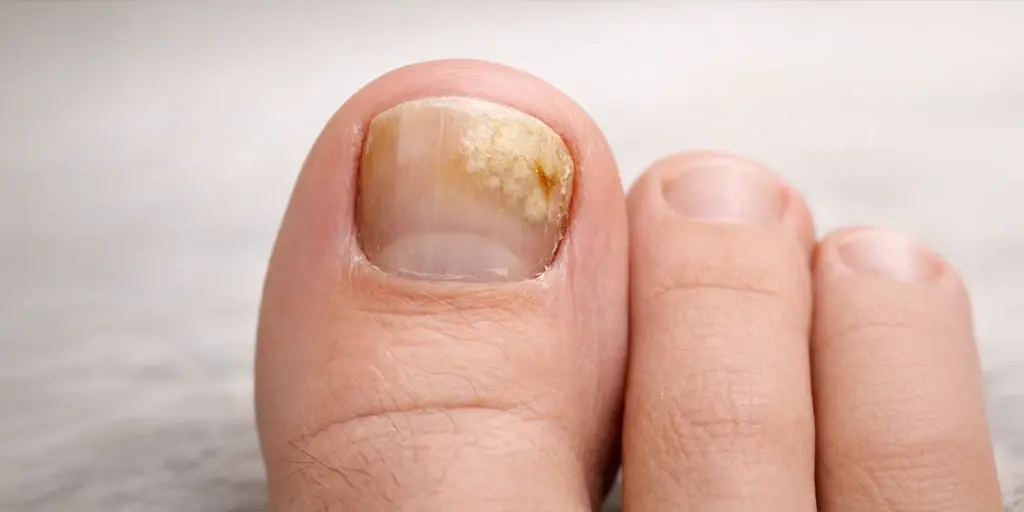
Initial stage - the first sign is usually a white or yellowish spot on the free end of the nail or under the plate, near the lateral edge. The nail still has normal consistency and does not hurt. This is the stage where treatment is most effective and quickest, but also the one that is most often ignored.
Intermediate stage - the discoloration progresses towards the base of the nail. The plate begins to thicken and lose its smooth texture. Areas of separation between the nail and nail bed (onycholysis) may appear, with whitish or yellowish material accumulating in this space. The nail may become brittle at the edges.
Advanced stage - the nail is clearly thickened, deformed and brittle. The color may range from yellow to dark brown or almost black depending on the type of fungus. Separation of the nail bed may be extensive. In some cases, odor appears. Cutting the nail becomes difficult because of its thickness and hardness.
Superficial white form - less frequent, affects the nail surface with white spots that can be scraped off. It is a more superficial form and generally has a better therapeutic prognosis.
Risk factors: who is more likely to develop it
Knowing the risk factors has practical value because several are modifiable:
Advanced age - prevalence increases progressively with age because of the sum of slower circulation, slower growing nails and longer cumulative exposure time to fungi.
Use of shared wet spaces - locker rooms, swimming pools, public showers, saunas and spas are the highest risk environments for dermatophyte transmission. Going barefoot in these spaces multiplies exposure.
Plantar hyperhidrosis - excessive sweating of the feet keeps the environment moist which favors fungal growth even outside at-risk areas.
Repeated nail trauma - overly tight footwear, impact sports activities and injuries that partially detach the nail from the nail bed create entry points for fungus.
Diabetes mellitus - the combination of immune impairment, peripheral neuropathy and compromised circulation makes people with diabetes 2 to 3 times more at risk of developing onychomycosis than the general population. In addition, in this setting, the infection is at greater risk of complications.
Immunosuppression - any condition or treatment that compromises the immune response (HIV, chemotherapy, prolonged systemic corticosteroids) significantly increases the risk.
Previous onychomycosis - having had nail fungus is one of the strongest risk factors for recurrence. The fungus can persist in footwear, socks and the home environment for months after treatment.
Diagnosis: why you should not treat without confirmation
This is the point that is most often omitted in practice and has the most consequences: not every yellow, thickened or deformed nail has fungus.
Nail psoriasis, lichen planus, chronic trauma, onycholysis due to mechanical detachment and certain nutritional deficiencies can produce nail changes that closely resemble onychomycosis. Treating a nail with antifungals without confirming the mycological diagnosis has two problems: if there is no fungus, the treatment is useless and the correct diagnosis is delayed; if there is fungus, not identifying the species can lead to using an antifungal to which the microorganism is resistant.
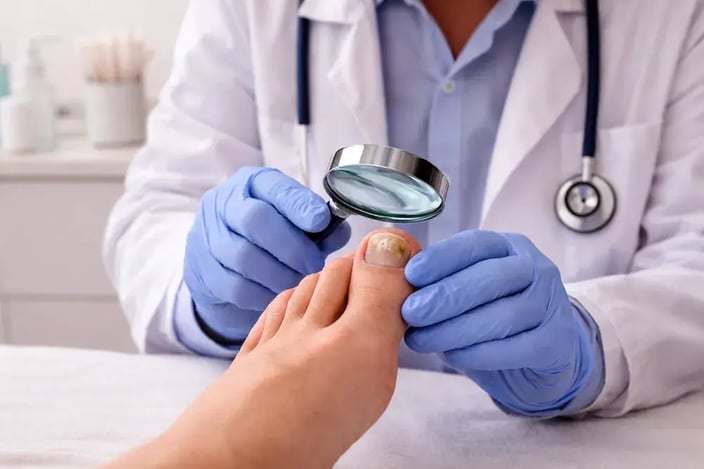
Confirmatory diagnosis requires a sample of the nail (scraping or clipping of the affected area) for mycological culture. The result takes 3-6 weeks because fungi grow slowly in culture. Some centers also use direct microscopic examination with potassium hydroxide (KOH), which gives a faster but less specific result.
In practice, many physicians initiate empirical treatment on clinical presentation when it is clear, but culture remains the standard for doubtful cases, relapses or when initial treatment does not work.
Treatment: what works and why it takes so long
Treatment of onychomycosis is effective, but requires patience and consistency. The main cause of failure is not resistance of the fungus to the antifungal - it is premature abandonment of treatment.
Oral antifungals
They are the treatment of choice for moderate-severe onychomycosis and for infections affecting the nail matrix (the area of active growth). Their advantage is that they reach the fungus through the bloodstream, acting from within the nail plate.
Terbinafine is the most widely used oral antifungal for dermatophyte onychomycosis. Its efficacy in dermatophytosis exceeds 70-80% in clinical trials. The usual regimen is 250 mg daily for 6 weeks for fingernails and 12 weeks for toenails. Terbinafine has a high affinity for keratinized tissue and persists in the nail for months after the end of treatment.
Itraconazole is used in pulses (one week treatment, three weeks off) or continuously. It is effective against dermatophytes as well as against yeasts and some molds, which makes it more versatile in cases of mixed infection or when the agent is not well identified.
Both require previous hepatic evaluation and follow-up in prolonged treatments, especially in people with hepatic history or taking concomitant medication.
Topical antifungals
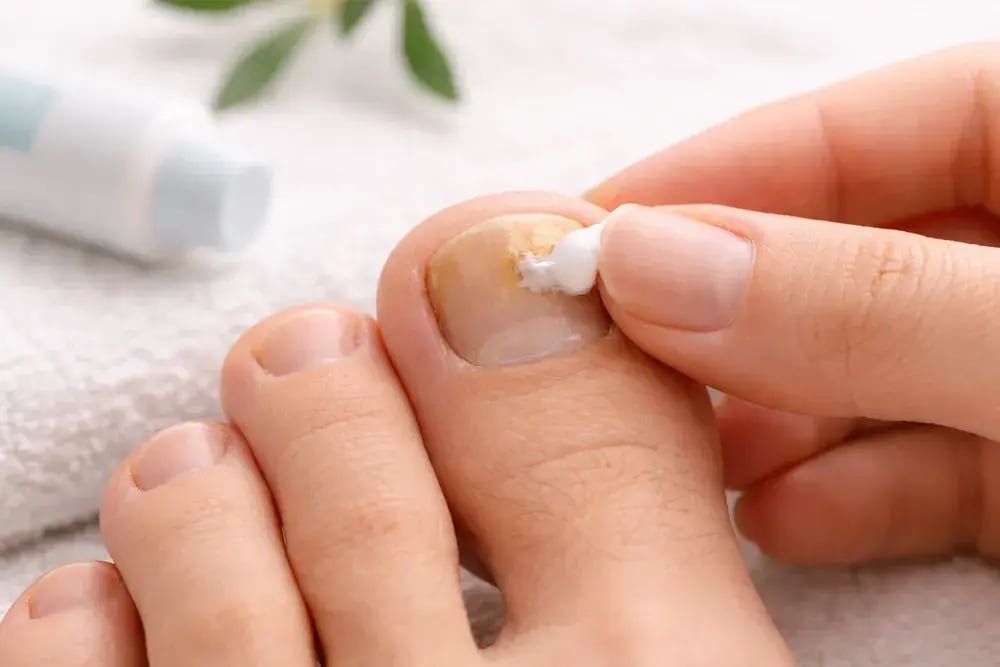
Topical antifungal lacquers and solutions (amorolfine, ciclopirox) are indicated for mild-moderate forms without matrix involvement, or as an adjunct to oral treatment. Their limitation is penetration: the nail plate is an effective barrier that makes it difficult for the concentration of the antifungal to reach the nail bed in sufficient quantities. To be effective they require very regular application (usually weekly or daily) for prolonged periods.
Why treatment lasts for months
Here is the explanation that very few guides clearly give: antifungals do not regenerate the damaged nail. What they do is eliminate the active fungus. The nail must grow out completely from the matrix for the affected plate to be replaced by healthy tissue. Since toenails grow 1-1.5 mm per month, it takes 9 to 18 months to replace a complete nail. Ending the antifungal when "the nail already looks better" but the infection has not been cleared from the matrix is a recipe for recurrence.
The criteria for cure is the combination of clinically normal nail plus negative culture, not just visual improvement.
The relationship between fungus and other nail pathologies
Onychomycosis often coexists with or promotes other nail conditions that are worth knowing about:
Fungi damage the structure of the nail plate in a way that predisposes to onychomycosis - the separation of the nail into layers. Once the infection weakens the organization of the keratin layers, the fragility persists even after the fungus is eliminated, until the plate regenerates completely with proper nutrition.
The onycholysis (separation of the nail from the nail bed) that results in onychomycosis creates a space under the plate that accumulates moisture and flaking keratin, which in turn facilitates secondary bacterial infections. In people with diabetes or compromised circulation, this scenario can evolve into more serious complications.
Fungi can also act as an aggravator of periungual and plantar skin. Fungal infection in the nail bed can spread to the skin at the edges and ball of the toe, contributing to the extreme dryness and heel cracks that characterize cracked feet.
Nutrition and nail health in the context of onychomycosis.
Nutrition does not cure an active fungal infection - that is done by antifungals. But it does play a real role at two points in the process:
During treatment, adequate nutrition in structural micronutrients (silicon, zinc, biotin, iron) ensures that the new nail plate that grows to replace the infected one does so with the correct structure - well-organized layers, adequate mechanical strength and reduced porosity. A nail that grows under suboptimal nutritional conditions can remain brittle even after the fungus is eliminated . If you want to delve deeper into how these nutrients affect the long-term quality of the plate, our complete guide to hair and nail nutrition details the role of each micronutrient in nail tissue regeneration.
In relapse prevention, maintaining good nail plate quality reduces structural entry points that facilitate reinfection. Dense, well-hydrated nails with cohesive layers are inherently more resistant to fungal penetration than brittle or porous nails.
Organic silicon has a specific role here: it acts as a cofactor in the synthesis of the keratin that forms the nail plate, improving the cohesion between layers and the mechanical resistance of the tissue. It is not an antifungal - but it is part of the structural support that helps the recovered nail maintain its quality. You can consult Silicium's organic silicon formulation for skin, hair and nails to learn how to incorporate it as part of your recovery protocol.

Prevention: how to reduce the risk of onychomycosis and recurrence
Prevention of onychomycosis has two distinct contexts: avoiding the first infection and preventing recurrence after treatment.
To avoid the first infection: Wearing footwear in locker rooms, showers and commonly used wet areas has the greatest impact on transmission. Drying feet thoroughly after bathing, especially between the toes, removes moisture that fungi need to grow. Wearing socks made of breathable natural fibers (cotton, merino wool) and alternating footwear to allow it to air out between uses reduces accumulated moisture.
To prevent recurrence: Footwear worn during infection may contain dermatophyte spores for months. Treating it with antifungal spray or replacing it directly is an often-overlooked preventive measure that accounts for many "unexplained" recurrences. Socks should also be washed at sufficient temperature (60°C or higher) to kill fungi. Pedicure tools (nail files, nail clippers) should be disinfected or for individual use.
Completing treatment to the point of healing - not just visual improvement - is the most important preventive measure of all.
Frequently asked questions about nail fungus
Does nail fungus spread to other people? Yes, although not as easily as other infections. Direct transmission from person to person is less frequent than indirect transmission through contaminated surfaces (floors, towels, pedicure utensils). In the domestic environment, the risk of transmission between cohabitants exists but is moderate if basic hygiene measures are maintained.
Can nail fungus be treated with home remedies? The most commonly used home remedies (tea tree oil, vinegar, baking soda, oregano oil) have documented antifungal properties in vitro - in laboratory conditions on cultures. However, clinical evidence in onychomycosis is very limited and none have demonstrated efficacy equivalent to antifungals in controlled trials. They may be useful as an adjunct in very superficial and mild forms, but are not substitutes for pharmacological treatment in established infections.
How long does it take for the infected nail to disappear? The infected nail does not "disappear" - it is gradually replaced by healthy tissue from the base. The complete replacement time for a toenail is 12-18 months. The antifungal kills the active fungus within weeks, but it takes that long for the damaged plate to be replaced. This is normal and does not mean that the treatment is not working.
Can I get a pedicure if I have nail fungus? Yes, but with precautions. It is important to inform the professional so that he/she can take extreme measures to disinfect the instruments. Pedicure salons are also a vector of transmission when instruments are not properly sterilized between clients.
Will nail fungus disappear on its own without treatment? In very superficial cases and with very low fungal load, theoretically yes - but this is exceptional. In practice, without treatment the infection progresses and spreads. Spontaneous resolution is not a scenario to plan for.
Why does my fungus come back after treatment? The most frequent causes of recurrence are premature abandonment of treatment before complete healing, failure to treat contaminated footwear or utensils, and re-exposure to the same risk environments without preventive measures. In some cases, what appears to be a recurrence is actually a reinfection due to re-exposure.
Reference source: The Spanish Society of Pediatric Infectious Diseases (SEIP) and the Spanish Academy of Dermatology and Venereology (AEDV) have clinical practice guidelines on dermatophytosis and onychomycosis with updated diagnostic and therapeutic criteria:
aedv.es
