

Red spots on the skin or ruby spots: What are they and why do they appear?
Have you noticed red spots on your skin and do not know why they have appeared? Petechiae are red spots of rounded shape and without relief that are caused by bleeding of the skin. As a general rule, their appearance is due to benign reasons such as exertion or coughing, but on other occasions, the reason may be different.
In this article, we will find out why red spots appear on the skin and how we can eliminate them. In addition, we will give you a series of tips to try to avoid their appearance. Read on!
Why do red spots or ruby spots appear on the skin?
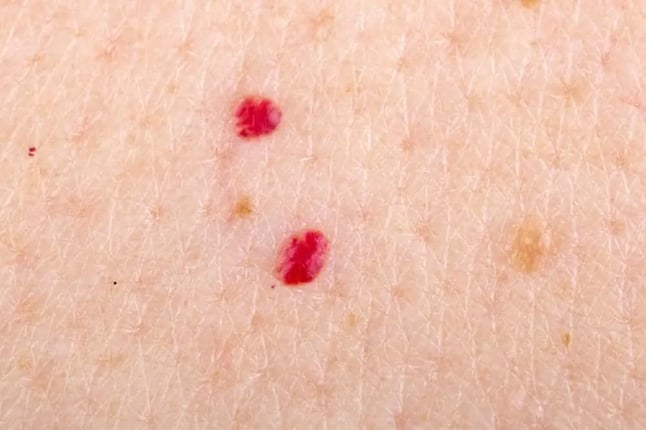
Red spots on the skin, or as they are also known, ruby spots arise when the capillaries of the skin bleed and blood spills out. This is the reason for their striking red color, although the shade can vary from reddish-brown to purplish. Petechiae are usually painless and do not cause itching or any other skin sensation. The most common areas where they usually appear are on the arms, legs, abdomen, as well as the mouth and eyes.
One way to distinguish red spots on the skin from other skin conditions is that when they are pressed, their color does not change in intensity or become whitish. It is important not to confuse them with red moles or ruby angiomas, which have a different vascular origin and their own causes and treatment options - if you want to better understand why red moles appear and how they are treated, the article specifically about them explains their differences from petechiae. Some of the factors that can cause Ruby spots are as follows:
- Skin aging. Petechiae usually appear after the age of 40, but they can also appear in younger people if there is a genetic factor.
- The sun. Although it is not a direct cause, it can affect white skin or skin that has not been properly protected from the sun.
- Hormonal changes, such as those that occur in the bodies of pregnant women.
- Genetics. These types of lesions have a genetic component, which means that if you have a family member who suffers from petechiae, you are more likely to suffer from them.
- Use of medications such as penicillin, quinine, phenytoin, anticoagulants, acetylsalicylic acid, among others.
- Prolonged exertion, either by coughing, vomiting, lifting, or giving birth.
- Infections caused by viruses or bacteria.
- Autoimmune diseases, liver or coagulation problems.
How are ruby spots diagnosed?
As we have seen, ruby spots are small red spots that appear on the skin and are caused by the proliferation of small blood vessels. Their diagnosis is generally clinical, i.e. based on direct observation of the lesions by a physician, usually a dermatologist.
Diagnostic steps:
- Physical examination: the physician examines the characteristics of the red spots, such as their shape, size, color and texture. Ruby spots are usually round, small and bright red or purple.
- Medical history: The patient may be asked when the spots appeared, if they have changed in size or appearance, or if there is a family history of ruby spots.
- Use of dermatoscope: In some cases, the dermatologist may use a dermatoscope, a special magnifying glass that allows a closer look at the skin lesions to determine if it is an angioma or other type of lesion.
- Biopsy (in some cases): If there is doubt about the nature of the lesion (for example, if there are unusual changes or if the physician suspects another type of tumor), a skin biopsy may be performed, which involves removing a small sample for laboratory analysis.
In most cases, red spots on the skin do not require treatment and are considered benign, but if a person notices changes in the lesions or wishes to remove them for cosmetic reasons, he or she can consult a dermatologist.
Should I be concerned about red spots on my skin?
Although the exact cause of red spots on the skin is currently unknown, there is nothing to worry about as they are not cancerous. It is a benign condition, but you should not forget about these spots. The best thing to do is to keep track of them and if any of the following warning signs appear, remember to go to a health professional for a diagnosis of your particular case and do not carry out any treatment at home on your own:
- Large amounts appear in a single specific area.
- The marks start to itch, bother or hurt, this type of spots does not cause any of this.
- If the red spots bleed when rubbed.
- If it changes color around the edges and changes texture.
How to treat red spots on the skin?
When red spots appear on the skin, the most important thing is not to try to remove them at home with natural methods because although it may seem harmless, it can become dangerous. So, if you are wondering if there is a solution to treat petechiae, the answer is yes. Currently, there are three very simple alternatives:
- Laser.
- Pulsed light.
- Radiofrequency scalpel.
But, if what you want is to prevent them or avoid the appearance of these red spots on the skin, here are some tips that will help you keep them at bay:
- Take food supplements such as Silicium G7 Siliplant based on organic silicon that contributes to the formation of collagen and eliminate toxins from the body.
- Follow a healthy and balanced diet. It is important to eat fruits and vegetables, as well as foods rich in omega-3 and 6.
- Stay well hydrated and drink at least 2 liters of water a day, hydration is essential for skin care.
- Use sunscreen to prevent photoaging.
- Cleanse your face regularly to keep your skin clean and healthy.
Now you know why red spots appear on the skin and what you can do to eliminate them, remember that it is important to monitor their appearance, shape and color. If they appear in large numbers or if their shape is suspicious, see a medical specialist as soon as possible.
