
Frontal Alopecia in Women: Causes and Natural Remedies
Causes such as nutritional deficiency or stress are behind frontal female alopecia. In addition to these factors, a new one of viral origin has been added in recent months and, following the pandemic, more cases of frontal female alopecia than ever before are beginning to be reported.
The worsening of hair health is one of the various side effects of the virus on the body, in many cases caused by the increased stress levels of the person infected during the symptomatic and recovery process.
What is frontal female alopecia and why does it occur?
Frontal female alopecia, if it is of the fibrous type, in addition to involving hair loss on the front and sides of the scalp, can also involve thinning hair in other areas, such as the eyebrows, eyelashes and other parts of the body. This disorder mainly affects women over the age of 50, although men and younger people can also suffer from it.
Although the exact cause of its appearance is still unknown, several investigations suggest that it could be an autoimmune reaction, where genetics or hormones play a key role.
According to a study by the University of Oxford, the relevant role of environmental factors that contribute to the appearance of this form of female frontal hair loss is being investigated .
Hence the importance of paying attention to nutrition, in particular vitamins (although it should be noted that we do not absorb all of them correctly, nor are they present in food in adequate amounts due to the heavy use of pesticides and current growing conditions).
It is also believed that hormones may be partially responsible, as it usually affects postmenopausal women and can occur along with genetic hair loss (also known as androgenetic or female pattern hair loss).
The body's immune system is affected, especially the T lymphocytes, a type of white blood cell. White blood cells are part of the body's immune system and are involved in fighting infections. When the body generates an immune response, this causes inflammation, which eventually destroys the hair follicles.
Symptoms of female frontal alopecia
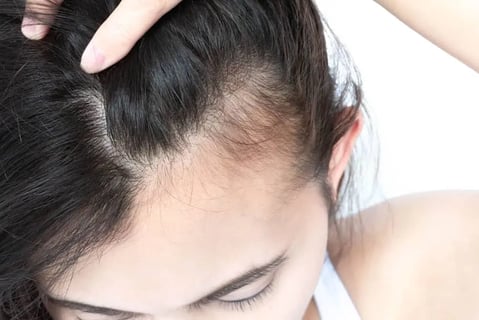
In addition to female frontal alopecia, which is noticeable by the gradual loss of hair density in this area, this condition is often accompanied by hair loss on the sides of the face, around the temples.
Hair loss on the eyebrows and eyelashes confirms that this is a problem that should be addressed as soon as possible.
Of all the symptoms of frontal female alopecia, the most obvious is that the hair that falls out does not come back, unlike what normally happens with hair cycles. As a result, the distance between each active follicle and the next one gets wider and wider.
Importance of early detection
Early detection of this disorder is key to nipping the issue in the bud. A medical examination will help to find out what the underlying cause is and try to find a remedy.
Sometimes it will be necessary to act to regulate hormones; at other times, priority will be given to acting on the level of inflammation in the body. It should be remembered that inflammation is a process that is often linked to cellular aging. Depending on the diagnosis, the specialist will indicate the most appropriate process or treatment to follow.
Is there a cure for frontal female alopecia?
Although there is no cure for female frontal fibrous alopecia, early treatment can help slow its progression. There are different treatments to strengthen the hair and regenerate it, although the most effective is prevention.
The aforementioned Oxford University research reports that topical scalp treatments such as creams, lotions and gels can be used. It is also possible to treat with tablets. However, success rates can be highly variable on a case-by-case basis.
Unfortunately, there is no single proven effective treatment and, despite trying many treatments, some people continue to notice hair loss. Because of this, some people opt for no treatment at all and decide to wait to see if the condition will stop on its own.
Hair transplantation may be an option, only once the condition has been stable for several years as otherwise the newly grafted hair will also be lost.
Tips to prevent frontal female alopecia

There are tips that may be useful to prevent frontal female alopecia and hair loss and deterioration. They have to do with:
- Diet. The lack of nutrients weakens the hair and this can further aggravate the problem you are suffering, whatever its origin. If the diet is not healthy and the necessary vitamins and minerals are lacking, the quality of the hair will deteriorate and the problems will increase in magnitude, accelerating as well.
- Habits. Lack of exercise, prolonged unprotected exposure to the sun, unmoderated alcohol and coffee consumption or smoking have a negative effect on scalp health. Stress is another factor that can lead to hair loss and should therefore be kept at bay.
- Supplements. To mitigate the negative effects of free radicals on the body, slow down the aging process, stop cellular inflammation and provide the skin, hair and nails with the nutrients they need, it is important to complement a balanced diet with supplements.
There are natural remedies, such as hair masks with homemade ingredients that improve the health and appearance of hair. However, they are not enough by themselves to prevent and alleviate the adverse effects of frontal female alopecia.
Products such as G7 Beauty, a natural nutricosmetic that, thanks to its composition with organic silicon and enriched with vitamin E and selenium, manages to provide hair with lost strength, while moisturizing and restructuring the skin. This supplement nourishes the body with antioxidants and its powerful effect is recognized in cell protection and fight against oxidative damage. What are you waiting for to try it?You won't take long to notice the results!
